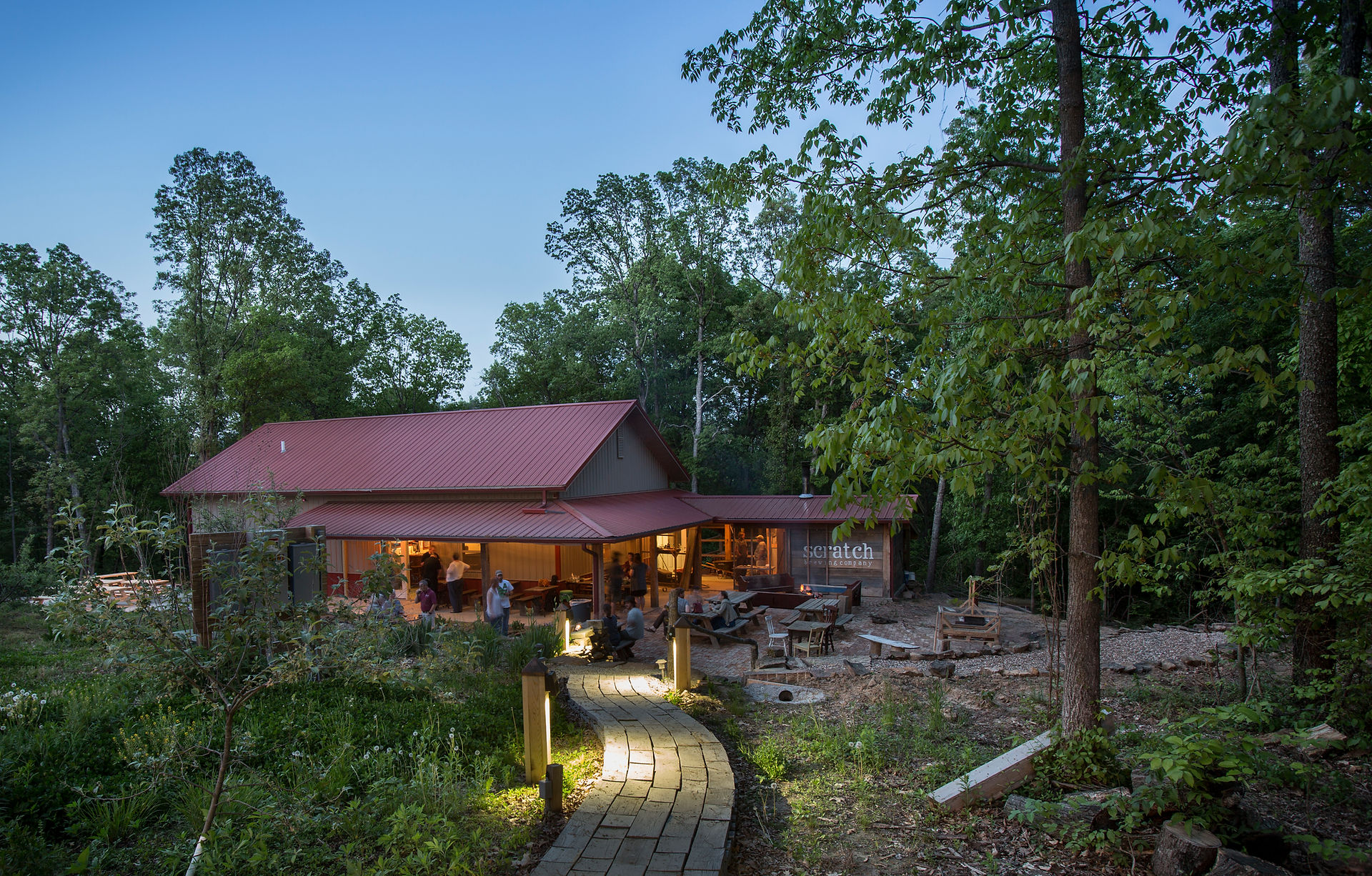
Keeping the "Farm" in "Farmhouse Beer"

Today Scratch is taking a radical stand about what it means to create "farmhouse" beer. In a novel print piece published with Good Beer Hunting and a short online abstract, co-owner Marika Josephson outlines 5 principles for creating beer that purports to come from a "farm" or be called "farmhouse beer": A brewery must grow a significant number of its ingredients on site, it must make beer with ingredients from its ecological growing region, it must utilize its own unique microflora, it must embrace its natural water profile, and it must operate within the bounds of its materials and means.
Marika explains in the Good Beer Hunting essay that taking a stand about how farmhouse beer is made is critical right now as the term is slowing losing meaning and the industry is changing. She writes: "As we watch the beer industry undergoing rapid changes, we see the temptation for many brewers to cut corners on their use of local agriculture, all the while claiming this is at the heart of their business. Some brewers legitimately do grow ingredients on-site, or have long-term intentions to do so, and otherwise support local farmers. Others set up breweries on picturesque plots of land, with no intention of growing their own—perhaps adding a small garden as an afterthought—or don’t otherwise support local growers. The problem is that all of these business models have been wrapped up into the idea of 'farmhouse' beer, and the word itself is beginning to lose its meaning. If farmhouse beer is just a picture on a label with nothing behind it, we are slowly destroying the notion of the small farm, and are undoing the work of small brewers who have invested significant time, money, and infrastructure into growing their own or supporting their local farms—an investment that often goes unrewarded."

That means that as of today, Scratch will be working to phase out the purchase of any grain and hops outside of its growing area. In 2019 all grain will come from Sugar Creek Malt, and all hops from Illinois growers who have invested significant time and money to new agricultural endeavors in our state. We will of course continue to grow our adjuncts on site and on land managed by our farmers, and only buy from other farmers what we can't grow ourselves. We will also continue to use our house mixed culture for almost all of our fermentations, working to source other yeast and bacteria from on site to supplement that culture over the course of the next year. Each principle and a full examination of what we do at Scratch is in the print essay and an overview is in the online abstract. We encourage all brewers who purport to make farmhouse beer to use the essay as a guide for examining their own breweries and practices.
This essay is a year in the making, as Marika and Aaron brainstormed what it means to make farmhouse beer in a modern craft brewing landscape, and Marika worked with Good Beer Hunting to create an accessible print essay. Watching small farms, young farmers, and rural communities living and dying by the globalization of agriculture, it has always been the mission of Scratch to support local growers and the diversification of crops. We've seen many talented people leave our region for lack of opportunities, whether they be farmers, artists, or entrepreneurs. We hope that taking a stand about the principles of our business practices encourages other breweries to do the same, and to invest in the foundation of a truly local economy in their region.


https://casinochf.com is where I've been reading about how businesses balance ideals against operating constraints, so Marika's point about operating within the bounds of materials and means resonated differently than the other four principles. Phasing out all outside grain and hops by 2019 is a concrete deadline most breweries would never commit to, and it makes me wonder how many would still call themselves farmhouse if they had to follow the same rules. The distinction between a picturesque plot and actual agricultural investment is the part I keep thinking about.
I think a Free Calculator works best when it stays focused on the basics. Most everyday calculations do not require complicated functions, so a clean interface that gives a quick result can be more useful than a feature-heavy application.
I found the Subhadra Yojana online apply instructions helpful and straightforward. Online registration is convenient for eligible beneficiaries, especially when the process is clearly explained. Applicants should carefully review their information before completing the final submission.
Thanks for sharing this detailed guide on SSSMID. The information is practical and well organized, helping users understand the process without needing additional assistance.
This insightful article delivers a much-needed framework to separate authentic farm-driven brewing from superficial farmhouse beer marketing. The five foundational criteria neatly distill the historical, ecological and ethical heart of traditional farmhouse ale production, filling a critical gap in craft beer discourse around transparent labeling. Wonderful educational brewing content, and I look forward to more deep dives into regional farm brewing traditions from Scratch Beer. . --words